
Toastie
Making chronic illnesses feel more manageable with the power of AI
Chronic illnesses impact 1 in 2 people globally. Toastie is an AI-powered health platform that reimagines how people can manage them.
I led the end-to-end design on their insights feature; the part of the app that transforms personal health data into something people can actually act on.
Chronic illnesses impact 1 in 2 people globally. Toastie is an AI-powered health platform that reimagines how people can manage them.
I led the end-to-end design on their insights feature; the part of the app that transforms personal health data into something people can actually act on. I worked directly with the two co-founders, and the work has since been recognised by the NSW Government and the Good Design Awards.
Chronic illnesses impact 1 in 2 people globally. Toastie is an AI-powered health platform that reimagines how people can manage them.
I led the end-to-end design on their insights feature; the part of the app that transforms personal health data into something people can actually act on. I worked directly with the two co-founders, and the work has since been recognised by the NSW Government and the Good Design Awards.
User Satisfaction
User Satisfaction
95%
of participants desired to use Toastie's AI insights and analytics
of participants desired to use Toastie's AI insights and analytics
User Completion
User Completion
90%
of participants successfully navigated the AI insights with ease
of participants successfully navigated the AI insights with ease
Recognition
Recognition
Good Design Award
Good Design Award
Winner of the Digital Apps and Software Category in 2025
Winner of the Digital Apps and Software Category in 2025
Recognition
Recognition
UNSW New Wave
UNSW New Wave
3x award winner
3x award winner
Context
Context
Chronic conditions take on average 7.6 years to diagnose, and the struggle doesn't end there
Chronic conditions take on average 7.6 years to diagnose, and the struggle doesn't end there
Rare and chronic illnesses are not only difficult to detect, but individuals who are finally diagnosed often feel uninformed and ill-equipped to manage their condition (Kirk et al., 2024).
With limited research funding and medical professionals who don't always have the time to provide comprehensive support, many people are left to navigate their health largely on their own.
Rare and chronic illnesses are not only difficult to detect, but individuals who are finally diagnosed often feel uninformed and ill-equipped to manage their condition (Kirk et al., 2024).
With limited research funding and medical professionals who don't always have the time to provide comprehensive support, many people are left to navigate their health largely on their own.
Rare and chronic illnesses are not only difficult to detect, but individuals who are finally diagnosed often feel uninformed and ill-equipped to manage their condition (Kirk et al., 2024).
With limited research funding and medical professionals who don't always have the time to provide comprehensive support, many people are left to navigate their health largely on their own.

The Problem
The Problem
Tracking symptoms feels standard, but understanding them is a different story
Tracking symptoms feels standard, but understanding them is a different story
Symptom tracking is a feature in almost every health app; but logging data is only half of it. The insights, trends, and health patterns that come from that data are rarely easy to interpret.
For someone already living with the anxiety and uncertainty of a chronic condition, a graph without context isn't helpful. It's just more noise.
Symptom tracking is a feature in almost every health app; but logging data is only half of it. The insights, trends, and health patterns that come from that data are rarely easy to interpret.
For someone already living with the anxiety and uncertainty of a chronic condition, a graph without context isn't helpful. It's just more noise.
Symptom tracking is a feature in almost every health app; but logging data is only half of it. The insights, trends, and health patterns that come from that data are rarely easy to interpret.
For someone already living with the anxiety and uncertainty of a chronic condition, a graph without context isn't helpful. It's just more noise.

A Unique Opportunity
A Unique Opportunity
Where machine learning meets human understanding
Where machine learning meets human understanding
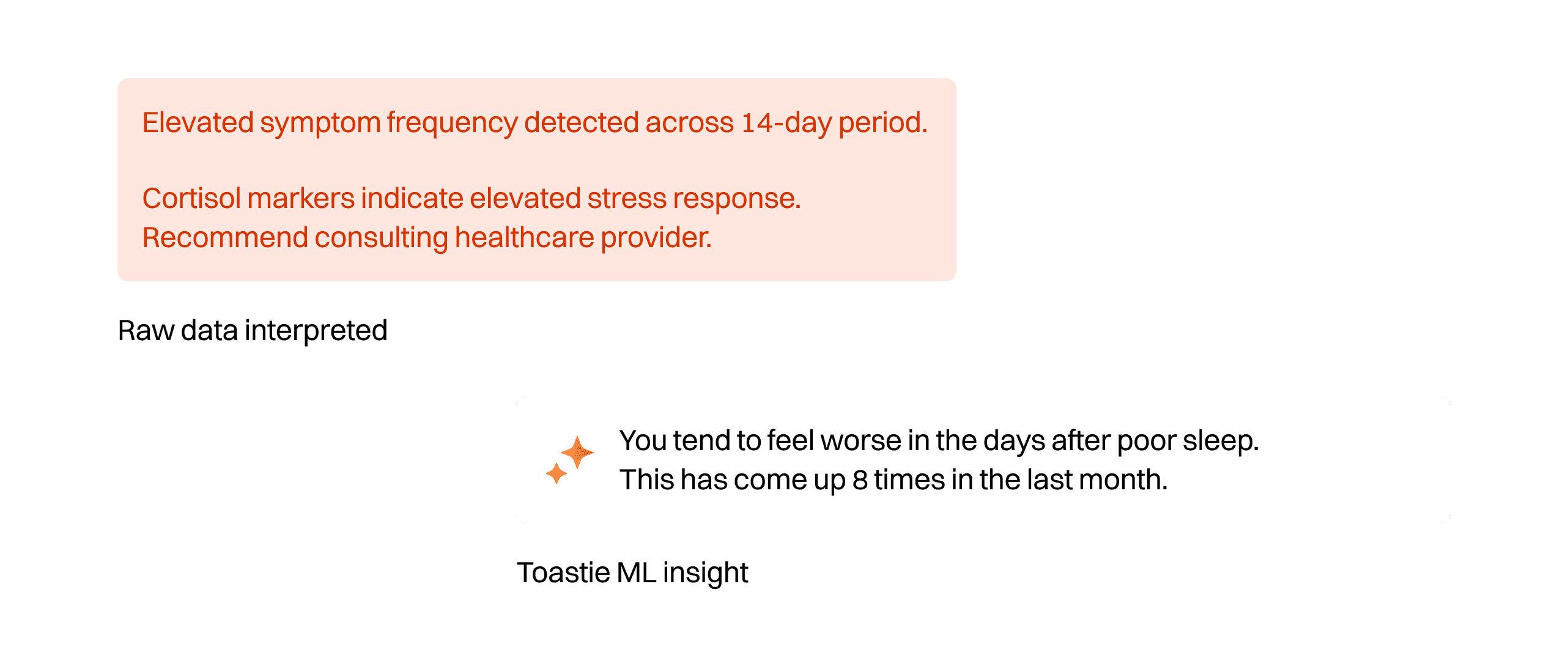
The gap between raw data and real insight is where Toastie's ML lives.
Your symptoms don't exist in isolation; diet, sleep, and stress are all connected. Toastie's ML engine analyses these connections and surfaces them as natural language insights. The shift from data to meaning is what makes it sticky.
The gap between raw data and real insight is where Toastie's ML lives.
Your symptoms don't exist in isolation; diet, sleep, and stress are all connected. Toastie's ML engine analyses these connections and surfaces them as natural language insights. The shift from data to meaning is what makes it sticky.
The gap between raw data and real insight is where Toastie's ML lives.
Your symptoms don't exist in isolation; diet, sleep, and stress are all connected. Toastie's ML engine analyses these connections and surfaces them as natural language insights. The shift from data to meaning is what makes it sticky.
The Solution
The Solution
Toastie's Insights Hub
Toastie's Insights Hub
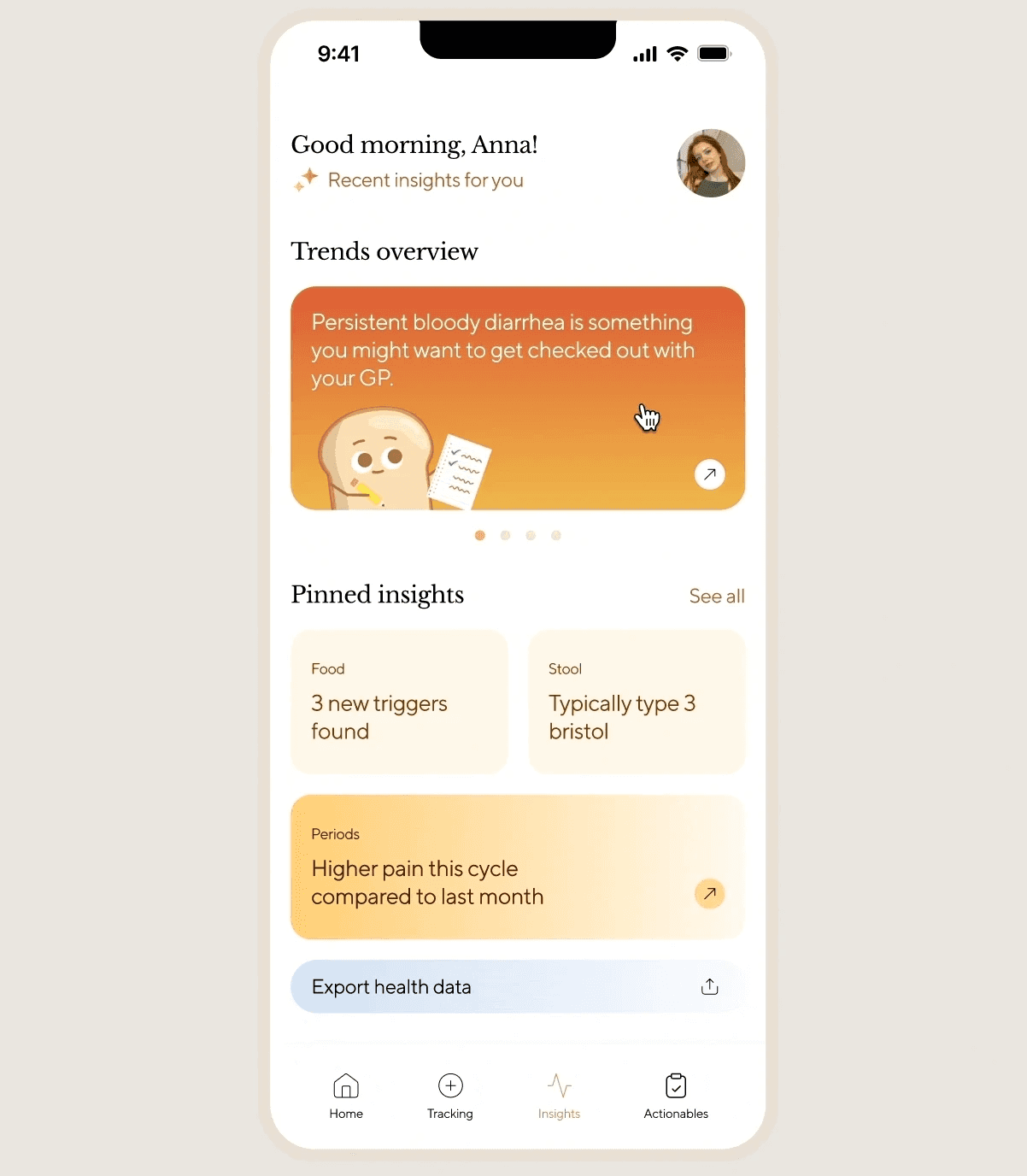
Meaningful correlations and health trends that are not only personalised, but digestible and actionable. Abnormal symptoms and patterns are flagged, suggestions are provided, and guesswork is eliminated.
Meaningful correlations and health trends that are not only personalised, but digestible and actionable. Abnormal symptoms and patterns are flagged, suggestions are provided, and guesswork is eliminated.
Meaningful correlations and health trends that are not only personalised, but digestible and actionable. Abnormal symptoms and patterns are flagged, suggestions are provided, and guesswork is eliminated.

Symptoms connected and explained
Tap for a clear breakdown of what's happening, why it might be occurring, and what to watch for.
Tap for a clear breakdown of what's happening, why it might be occurring, and what to watch for.

Walk into any appointment prepared
Export everything you've tracked. Download notes for your doctor, your family, or your own records.
Export everything you've tracked. Download notes for your doctor, your family, or your own records.
The Research Behind It
The Research Behind It
People want to be in control of their health without being overwhelmed
People want to be in control of their health without being overwhelmed
We recruited Australians living with chronic conditions and ran empathy interviews and surveys to understand what their reality actually looked like.
We found that people were struggling with anxiety, fear, and other co-morbidities which made managing their health feel impossible and exhausting.
We recruited Australians living with chronic conditions and ran empathy interviews and surveys to understand what their reality actually looked like.
We found that people were struggling with anxiety, fear, and other co-morbidities which made managing their health feel impossible and exhausting.
We recruited Australians living with chronic conditions and ran empathy interviews and surveys to understand what their reality actually looked like.
We found that people were struggling with anxiety, fear, and other co-morbidities which made managing their health feel impossible and exhausting.
Key Insights
Key Insights
"I want to understand the root cause of my condition… not a bandaid solution."
"I want to understand the root cause of my condition… not a bandaid solution."
"I want to know when to see a doctor or get a diagnnosis."
"I want to know when to see a doctor or get a diagnnosis."
85%
of participants abandoned health tracking apps after a few weeks because it didn't help them make sense of their symptoms
of participants abandoned health tracking apps after a few weeks because it didn't help them make sense of their symptoms
"I want to understand the root cause of my condition… not a bandaid solution."
"I want to know when to see a doctor or get a diagnnosis."
85%
of participants abandoned health tracking apps after a few weeks because it didn't help them make sense of their symptoms
Design Decisions
Design Decisions
There is such thing as TMI (too much information)
There is such thing as TMI (too much information)
Our participants told us that they wanted more information because they often felt anxious and lost without enough. We quickly realised that surfacing too much data, or data without context, led them to confusion rather than clarity.
We had to fine tune a healthy balance of giving them enough, but also giving them the right thing.
Our participants told us that they wanted more information because they often felt anxious and lost without enough. We quickly realised that surfacing too much data, or data without context, led them to confusion rather than clarity.
We had to fine tune a healthy balance of giving them enough, but also giving them the right thing.
Our participants told us that they wanted more information because they often felt anxious and lost without enough. We quickly realised that surfacing too much data, or data without context, led them to confusion rather than clarity.
We had to fine tune a healthy balance of giving them enough, but also giving them the right thing.
Before
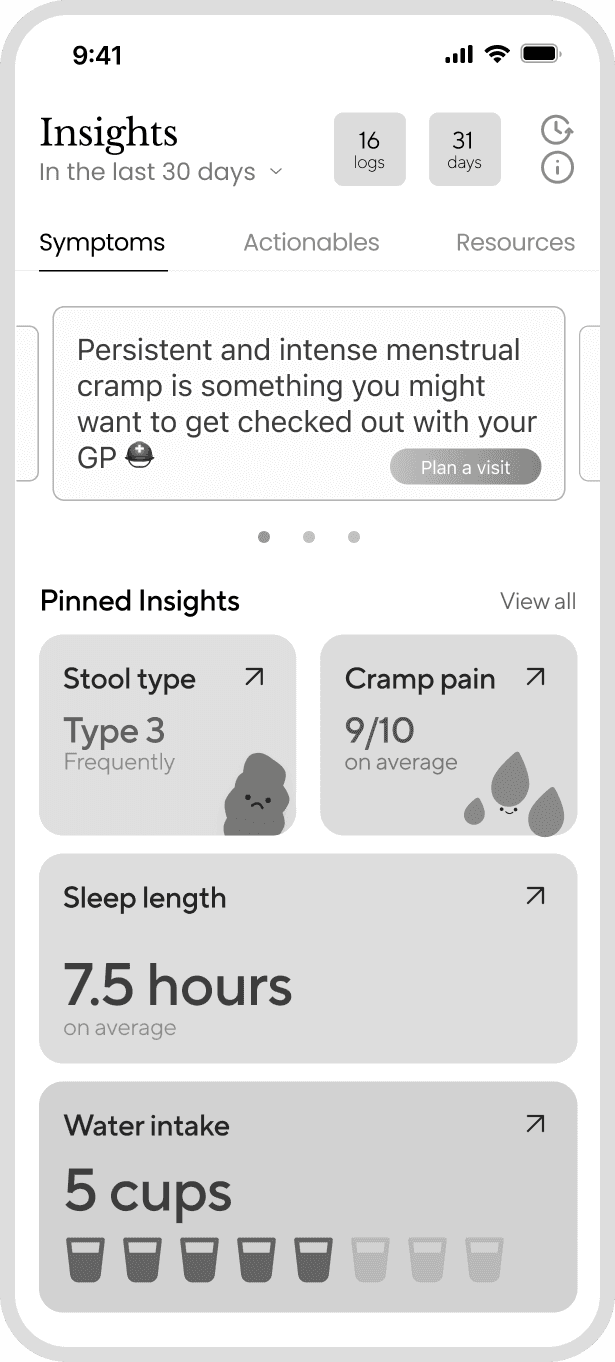
Users felt that the page was very scattered and the overload of information made it hard to see what was important
Users felt that the page was very scattered and the overload of information made it hard to see what was important
After

We cleaned up the information architecture and moved actionables and resources into each symptom so things felt more holistic
We cleaned up the information architecture and moved actionables and resources into each symptom so things felt more holistic
Design Decisions
Design Decisions
Changing the approach to presenting health data, because most of them felt too clinical
Changing the approach to presenting health data, because most of them felt too clinical
Early explorations leaned on transparent medical information. It read like a report rather than a conversation about health, and we realised that we needed something warmer and personal to resonate with. We iterated with colours, typography, mascot designs, and copywriting to find a good middle.
Early explorations leaned on transparent medical information. It read like a report rather than a conversation about health, and we realised that we needed something warmer and personal to resonate with. We iterated with colours, typography, mascot designs, and copywriting to find a good middle.
Early explorations leaned on transparent medical information. It read like a report rather than a conversation about health, and we realised that we needed something warmer and personal to resonate with. We iterated with colours, typography, mascot designs, and copywriting to find a good middle.

An Awkward Moment
An Awkward Moment
We were falling short of our users' basic needs
We were falling short of our users' basic needs
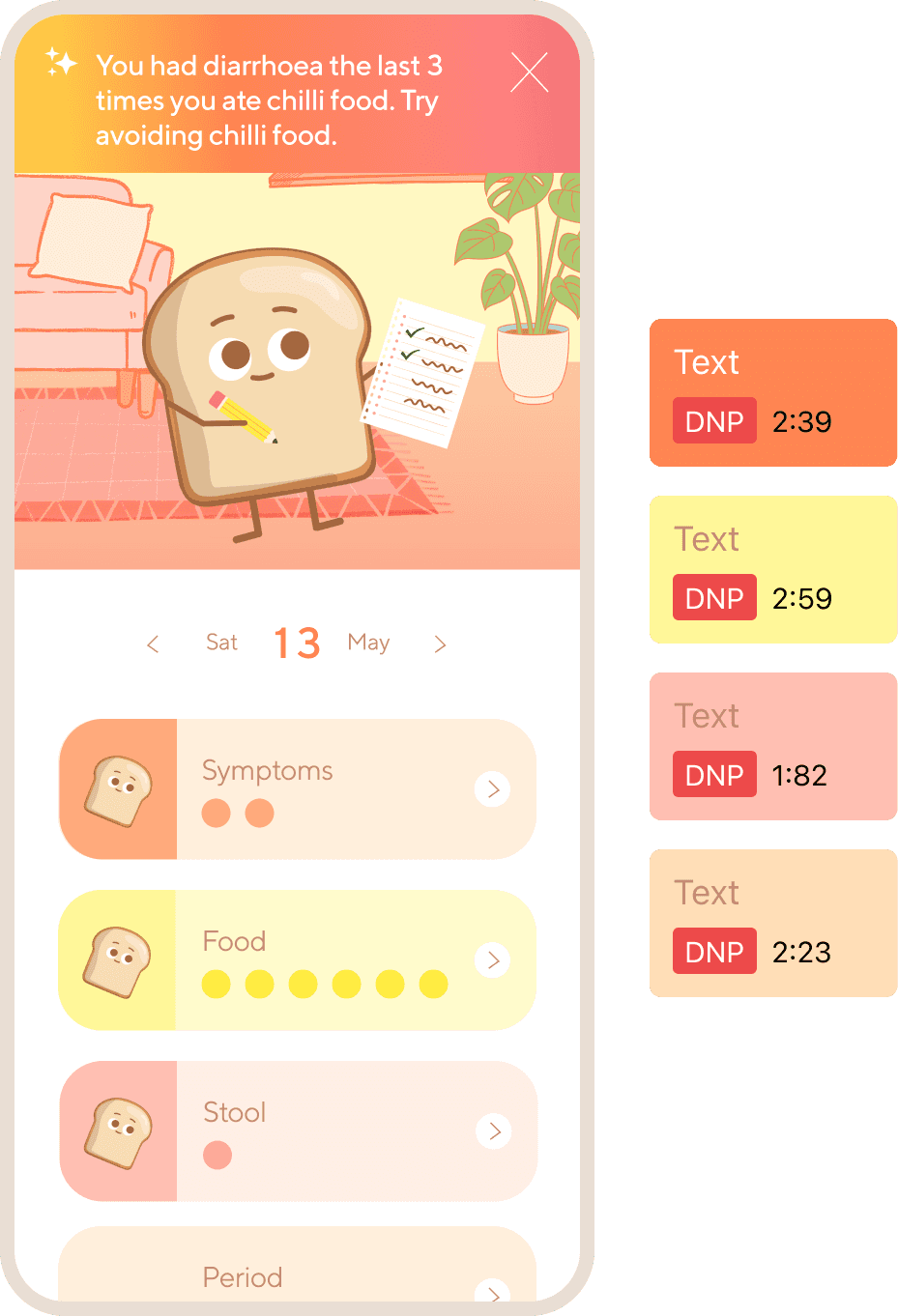
Midway through the project, we found that Toastie's existing interface was failing WCAG accessibility standards. For a product built for people with chronic illnesses, many of whom have disabilities or sensory sensitivities, this was a high value problem. We flagged it to the founders immediately and rebuilt the UI as we designed the screens.
Midway through the project, we found that Toastie's existing interface was failing WCAG accessibility standards. For a product built for people with chronic illnesses, many of whom have disabilities or sensory sensitivities, this was a high value problem. We flagged it to the founders immediately and rebuilt the UI as we designed the screens.
Midway through the project, we found that Toastie's existing interface was failing WCAG accessibility standards. For a product built for people with chronic illnesses, many of whom have disabilities or sensory sensitivities, this was a high value problem. We flagged it to the founders immediately and rebuilt the UI as we designed the screens.
Before
After

Key Learnings
Key Learnings
A lot of iteration doesn't mean we're failing, it's actually leading us to success
A lot of iteration doesn't mean we're failing, it's actually leading us to success
There needs to be a better way for people to understand and manage their health, especially when there is no cure.
Designing with AI was pulling the team into multiple directions almost all the time. Finding the right tone, the right language, and the right level of personalisation proved to be a really difficult and hefty task.
Every round of testing revealed a moment where the experience had tipped too clinical, too detached, or too overwhelming. We kept testing and iterating on the work, and there was no shortcut to it all, we went back to users and pivoted again and again to make sure we were getting it right.
Designing with AI was pulling the team into multiple directions almost all the time. Finding the right tone, the right language, and the right level of personalisation proved to be a really difficult and hefty task.
Every round of testing revealed a moment where the experience had tipped too clinical, too detached, or too overwhelming. We kept testing and iterating on the work, and there was no shortcut to it all, we went back to users and pivoted again and again to make sure we were getting it right.
Wanna See More?
Wanna See More?
There needs to be a better way for people to understand and manage their health, especially when there is no cure.
This is just a snapshot of the entire project! If you'd like to hear more about the process feel free to reach out to me at chelseavlastalowell@gmail.com
This is just a snapshot of the entire project! If you'd like to hear more about the process feel free to reach out to me at chelseavlastalowell@gmail.com